
Beyond Wordle: The New York Times Games Section, Explained
Wordle has officially joined the New York Times Games section: The viral word puzzle is now part of a robust portfolio that includes Spelling Bee, Letter Boxed and the legendary New York Times daily crossword.
"If you've followed along with the story of Wordle, you'll know that New York Times Games play a big part in its origins, and so this step feels very natural to me," Worlde creator Josh Wardle tweeted.
Last year, New York Times Games reached 1 million subscribers, and the paper's online games were played more than 500 million times.
Here's everything you need to know about the puzzles in the New York Times Games family, including how to play them.
For more, find out how to start playing Wordle, tips on how to best guess the daily word and how to download Wordle to keep it free forever.

Many Wordle players like to start with words with many vowels
Screenshot by Mark Serrels/CNETWordle
The Times announced it acquired Wordle at the end of January, for an undisclosed sum in the "low seven figures."
On the off chance you've never played, the immensely popular word game gives you six chances to guess a five-letter word.
If the right letter is in the right spot, it shows up in a green box, while a correct letter in the wrong spot shows up in yellow. A letter that isn't in the word at all shows up gray.
Wordle players have all kinds of strategies -- including starter words, like "ADIEU" and "ROATE," that are heavy on vowels.
And despite complaints, the daily word game has not gotten more difficult since it was purchased by the Times.
"Nothing has changed about the gameplay," Times' communications director Jordan Cohen told CNET in an email. In fact, all the words in Wordle for the next five years were written into a script before the game launched in October 2021. (Spoiler: You can view that script on Medium.)
Spelling Bee
Outside of the daily crossword puzzle, Spelling Bee has the most devout following, with a daily column by Isaac Aronow and more than 600 comments a day on average.
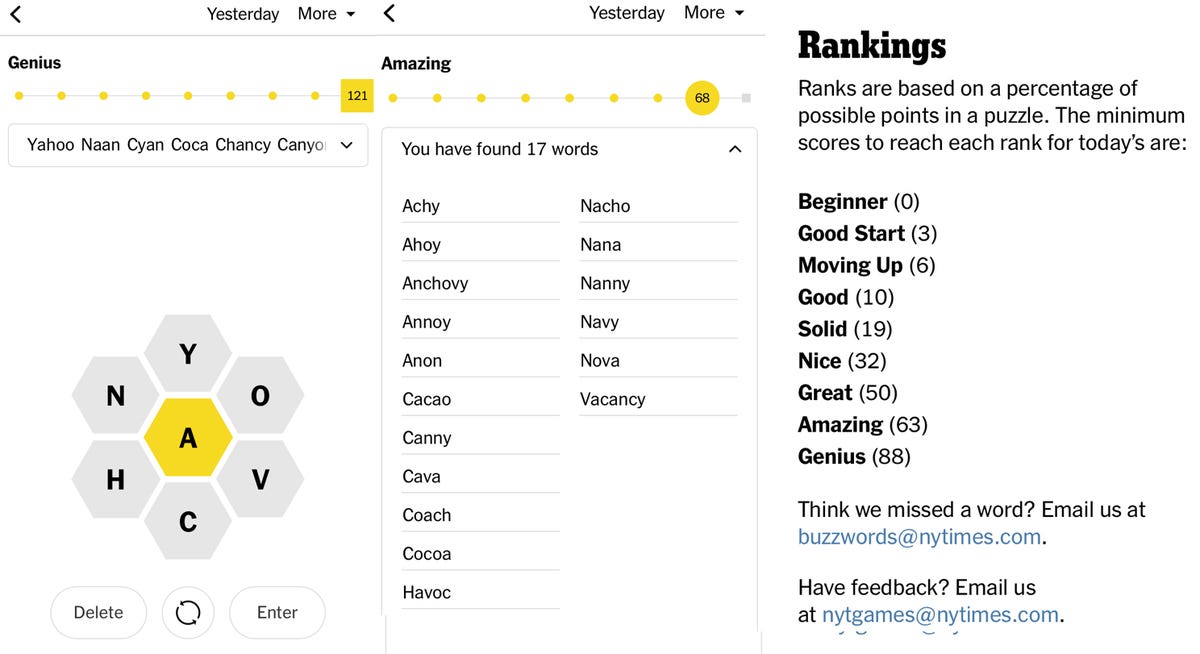
Spelling Bee started out as a weekly puzzle in the New York Times magazine before becoming a daily feature on the NYT Games app in 2018.
New York Times/Screenshot by Dan Avery/CNETIt's easy to learn the game but tough to master it: Each puzzle features a seven-cell honeycomb, with six letters arranged around a seventh in the center.
Players simply come up with as many words containing at least four letters as they can. You can reuse letters as often as you want, but each word must contain the center letter.
Words with four letters are worth one point, while longer words receive more. (A "pangram" uses all seven letters at least once. )
Proper nouns aren't recognized, nor are obscure or obscene words -- but exactly what qualifies as obscure is hotly debated through multiple threads.
"Of course, everyone has a different opinion about whether a clue or word is 'fair,' and solvers are not afraid to express that," Wordplay columnist Deb Amlen told CNET. "But don't all families disagree sometimes?"
The Spelling Bee comment section is filled with gripes and brags, peppered between clues to help struggling members of the Hivemind figure out all the possible words and achieve "Queen Bee" status.
Spelling Bee enthusiast Nancy Pfeffer became so enamored with the game's online "family" that she embarked on a 5,000-mile cross-country road trip last summer to meet some of her fellow players in person.
"What comes to mind when I think about our solvers is 'community,' in the best meaning of the word," Amlen said.
"I can't think of any other newspaper games section that draws such a devoted and enthusiastic audience," she said. "Wordplay commenters have helped and supported each other when personal problems arise. There are local Wordplay groups that meet up in real life to get to know each other. Our games act as a kind of social outlet for like-minded puzzle lovers."
The game launched as a weekly feature in The New York Times Magazine in 2014 and a daily digital edition debuted four years later.
As of August last year, Spelling Bee has been maintained by Sam Ezersky, who constructs the puzzles, decides what words are acceptable and posts the new game at midnight PT (3 a.m. ET).
And, yes, there are people up at 3 a.m. waiting for the new Bee.
Read on: 10 Tips to Winning the New York Times Spelling Bee
The Mini crossword
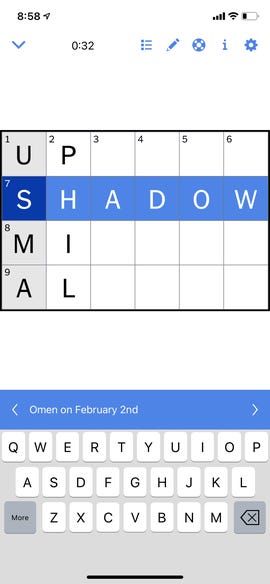
The NYT Mini crossword offers a five-by-five grid Sunday through Friday and a seven-by-seven layout on Saturday.
New York Times/Screenshot by Dan Avery/CNETSometimes you don't have the time, energy or gray matter to work on a full-blown New York Times crossword puzzle. Since 2014, the Times has offered an easier, smaller puzzle, designed by cruciverbalist Joel Fagliano, now digital puzzle editor at the Times.
The Mini is an amuse-bouche of a crossword, with a simple five-by-five grid Sunday through Friday and a seven-by-seven layout on Saturday. (Occasionally larger "midi" puzzles with 11-by-11 layouts pop up, too.)
Even within that limited space, Fagliano has devised something of a formula, as he told the Poynter Institute for Media Studies: "Six or seven clues that are pretty easy, two that are trivia and two that are a bit more cryptic."
If you've been too intimidated to try your hand at a Times crossword, a Mini is definitely a good place to start.
Letter Boxed
Launched in 2019, Letter Boxed, like Spelling Bee, relies more on vocabulary than knowledge of trivia: Three letters are featured on each side of a square and players must connect the letters to make words that are at least three letters long. The final letter of one word becomes the first letter of the next.
The catch, though, is that letters on the same side of the "box" can't be used consecutively.
The aim is to use all 12 letters by making as few words as possible. But, unlike a crossword, there's no one route to success. (The Times' answer to yesterday's puzzle, as a result, is just labeled "Our Solution.")
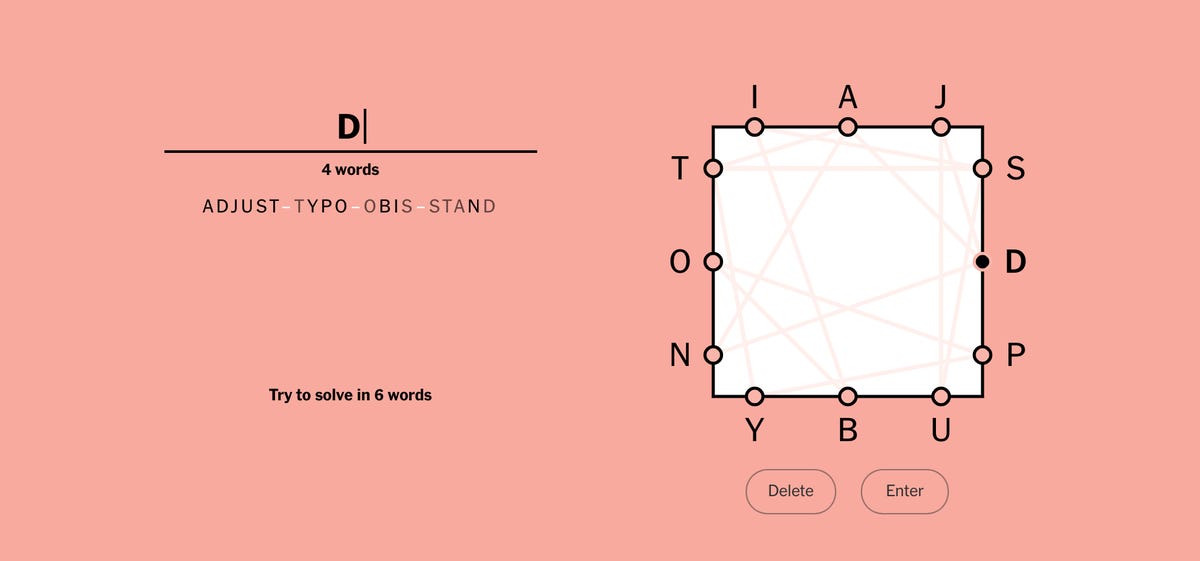
In Letter Boxed, letters on the same side of the square can't be used consecutively.
New York TimesVertex
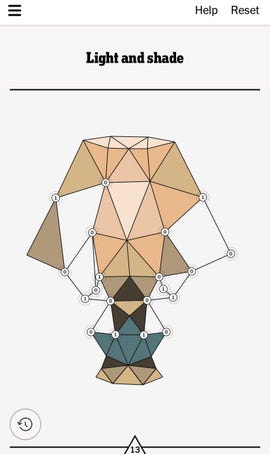
An example of a Vertex puzzle with numerous triangles shaded in giving a glimpse at the finished image hinted at above.
New York Times/Screenshot by Dan Avery/CNETEschewing words altogether, Vertex is an interactive version of a tangram, a Chinese geometric puzzle, that allows users to connect dots to create triangles that ultimately form a larger image.
"At its core, a vertex puzzle is a drawing game with a logic component," according to an article on the Times website.
The number on a dot indicates how many connections it has to other dots. If you link vertices correctly, the triangle they form will be filled in a specific color.
Tiles
The Times debuted Tiles, its first nonword game, in June 2019. It's a high-concept, artfully designed take on the classic tile game Mahjong solitaire.
Instead of Chinese characters and symbols, though, users try to match squares featuring intricate patterns -- some are inspired by hand-painted Portuguese Azulejo tiles, others by the work of 1970s Op artist Bridget Riley and German color theorist Josef Albers.
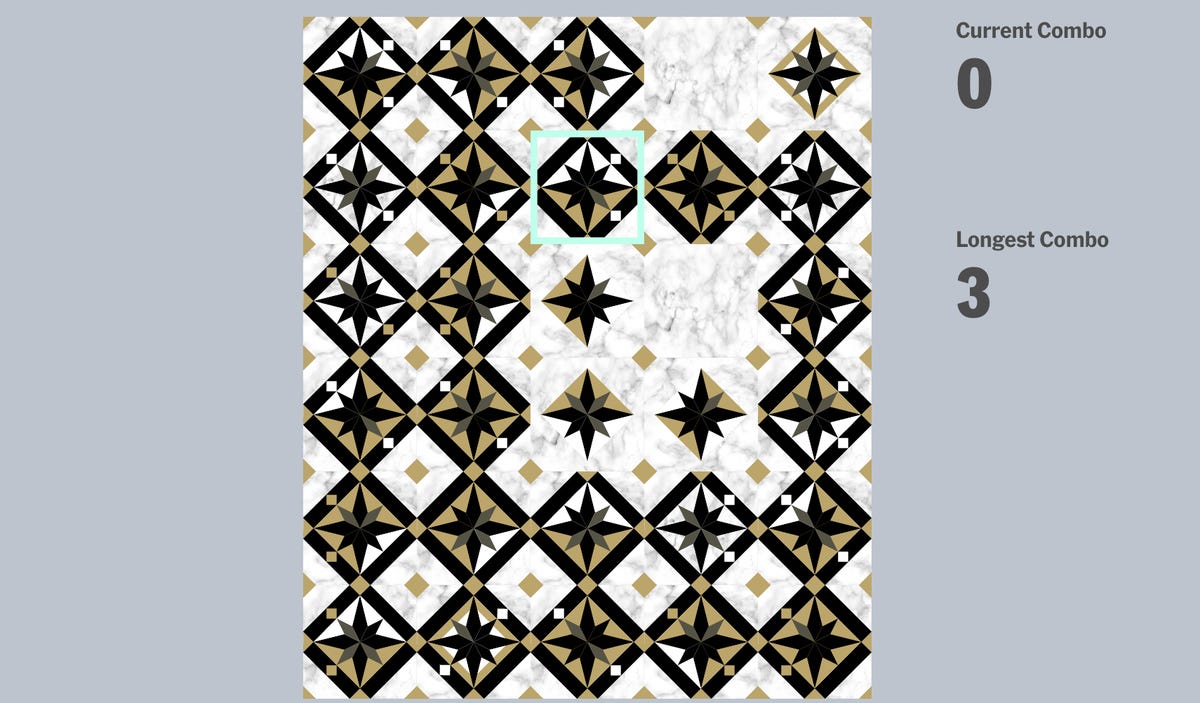
A screenshot of a Tiles game.
New York Times/Screenshot by Dan Avery/CNETPlayers click on matching pairs to make them disappear until they've cleared the entire board. But the variations in the tile patterns are far more subtle than in traditional Chinese mahjong tiles, making the game significantly more difficult.
Unlike crosswords, which appeal to completists, Tiles is aimed at a more meditative player. In fact, there's even a "zen mode" that goes on forever without clearing the board.
"One additional strategy around launching Tiles is to reach users who may not be native English-language speakers," The Times wrote a release announcing the game.

The app version of the famous crossword puzzle.
New York Times/Screenshot by Dan Avery/CNETThe New York Times crossword puzzle
The main draw for Games subscribers is online access to the venerable New York Times crossword puzzle that you can solve on your phone. Not just the current puzzle, but the daily archives going back to November 1993. Subscribers also get access to the new crossword the evening before it appears in print.
The app version of the Times puzzle has an autocheck feature that immediately tells you if you've entered the wrong letter. If you're stuck, you can also have the app "reveal" a square, word or the remainder of the puzzle.
More competitive players can track their solve rate and stats and see how they compare to other players on a leaderboard.
How much is a New York Times Games subscription?
Distinct from the main Times subscription, a New York Times Games digital subscription costs $5 a month or $40 for a year, and includes Spelling Bee, Letter Boxed, Tiles, Vertex and the daily crossword puzzle.
The Times offers the Mini and the logic puzzle Sudoku for free to nonsubscribers. For now, Wordle will also be free for nonsubscribers.
Read more: Finished Wordle? Try one of these similar games
Source
