Where can i watch the hidden how to view hidden how many people watch this is us is it normal to watch what do people like to watch do older people need more protein do older people need more sleep do some people need more sleep than others does steam support need more people the world needs more purple people activities more people live in this circle

More People Need to Watch This Hidden Superhero Gem on HBO Max
Superman has never been an easy character to relate to. He is, essentially, a perfect being. Because he's the most powerful and morally pure character in the DC universe, there's not a lot of drama or internal conflict to mine from the Man of Steel. Contrast this with Batman, whose dark and flawed character makes him a fan favorite.
Of course, in the Marvel universe you have complex characters like The Falcon and the Winter Soldier and Loki, who headline their respective hit shows on Disney Plus. In comparison, Superman & Lois, which aired on The CW network and is now streaming on HBO Max, has flown under the radar. But it may be more impressive, because it achieved a seemingly impossible goal: Create a version of Superman that retains his Boy Scout personality but still makes him relatable. The show does so by focusing on the theme of family, breathing new life into the franchise.
As a result, Superman & Lois may be the best iteration of Superman in TV or film. And this is coming from someone who watched Christopher Reeve's pitch-perfect performance at just the right age for it to leave a permanent impression.
The Reeve portrayal is one to be placed on a pedestal. But this new version speaks to me to an almost frighteningly personal degree. The new version of Clark Kent, played by Tyler Hoechlin, has been married to Lois for a while, and has two teenage boys. I'm also a father of two young boys. As amazing as Superman is at averting nuclear meltdowns or fending off rogue Kryptonians, he struggles to be a good father and makes bad decisions with the best of intentions. I can relate. (To the fatherhood bits anyway.)
That's not to say you need to be a father of two to appreciate the show. While it's technically part of the CW's "Arrowverse" universe of DC comic shows like The Flash and Supergirl, it stands apart and feels different from everything that's come before it. The budget and production values are markedly higher, and the show is structured differently.
Where The Flash and Supergirl feature a group of do-gooders fighting off a threat of the week, Superman & Lois is a fascinating mashup of a typical comic book show and something grounded, like Friday Night Lights. There's a healthy amount of time spent on developing characters, who act like they're real people and not figures in some drama.
Hoechlin's Superman (or Kent) isn't the only character to root for in this show. Bitsie Tulloch is a force of nature as Lois Lane, showing her strength not just as a hard-nosed investigative journalist but as a protective mother. A large chunk of season 1 sees Lois working with local reporter Chrissy Beppo (Sofia Hasmik) to investigate a story, with discussions of actual journalism work, which again hits near and dear to my heart.
But perhaps the most surprising elements are Lois and Clark's teenage sons, Jonathan (Jordan Elsass) and Jordan (Alex Garfin). These characters could've easily been annoying or gotten wrapped up in the kind of melodrama that typical TV teenagers get into. At first blush, Jonathan, a quarterback, and Jordan, an awkward brooder, fall into the usual cliches.
But instead, the link between these two brothers, one of whom -- light spoilers! -- develops superpowers, serves as a centerpiece of the show. Yes, they get into conflicts, and there are misunderstandings. There's jealousy and teenage gripes. But at the end of the day, the two talk like actual people and display an enduring level of support for each other.
The core family, flanked by a host of supporting characters who refuse to be typecast or go the obvious route, make for a show that's as enjoyable when they're hanging out at a local cafe as it is when Superman takes on an Iron Man-esque armored adversary. Emmanuelle Chriqui is a Lang Lang who's more world-weary than we remember, while Adam Rayner is deliciously devious as primary villain Morgan Edge. Wolé Parks, who plays the mysterious "Stranger" (hinted to be Lex Luthor... or not?) has one of the most satisfying character arcs in the show.
That's not to say there isn't loads of action. Superman & Lois takes its time with setting up the pieces, but that expanded budget ensured there were a number of set pieces that displayed the Man of Steel's power. From the cinematography to the special effects, the show is a big step up from the standard CW show.
The first season starts slow, but the arcs pick up the pace near the end, with twists and epic battles between superpowered figures and all the stakes of any major comic book franchise. Plot points and clues buried early in the season pay off with almost overwhelming speed, and you're left with a satisfied conclusion.
It's telling that the final scene of the show, which creates a huge cliff-hanger for the following season, isn't about some world-ending threat or new villain. It's about how the dynamics of the Kent family will change in interesting and even awkward ways.
Superman & Lois has been green-lit for a third season. So you're safe knowing that your commitment to this first season will get some payoff.
And if you're a die-hard Marvel fan, it's a great placeholder until the next big Disney Plus show.
Source
Intel s thunderbolt pushes into mainstream as faster as you can intel s thunderbolt pushes into mainstream asl intel s thunderbolt pushes into mainstream assistive technology intel s thunderbolt pushes into mainstream asx intel s thunderbolt pushes into mainstream synonym intel s thunderbolt pushes and pulls intel s thunderbolt pushes meaning intel s thunderbolt pushes me away intel stock prices today intel smart sound technology driver intel stock today intel stock symbol

Intel's Thunderbolt pushes into mainstream as faster alternative to USB
Thunderbolt, Intel's super-speedy connection technology, isn't widely used. But that may change in the coming year, as more computer makers incorporate the USB competitor into their new models.
Intel has hoped Thunderbolt, which debuted in 2011 on Apple's 2011 MacBook Pro, would become commonplace for computer users. A year later, the chipmaker forecast that "most PCs" would have Thunderbolt by 2015 to 2017. Despite the hype, only premium PCs carry the fast connection.
To get a boost in adoption, Intel has built Thunderbolt into its newest Core processors, code-named Tiger Lake, which means laptop makers get Thunderbolt without having to pay extra for separate controller chips. Because Intel chips are so widely used, the company says Thunderbolt will now have its moment to shine.
"I would expect by 2022 Thunderbolt will be in more than 50% of the PCs sold," said Jason Ziller, who runs Intel's connectivity products, adding that more than half of laptops that ship in the next year will "definitely" carry the technology. Ziller has led Thunderbolt work since before it debuted in Apple's 2011 MacBook Pro laptops almost exactly 10 years ago.
PC ports don't capture the imagination the way fast processors or smartphone cameras do. But they're a crucial part of most people's computing experience. Thunderbolt ports provide fast and versatile connections to external storage devices, monitors, network adapters and other peripherals. They can replace ports for HDMI, DisplayPort, Ethernet and power. The new Thunderbolt 4 lets multiport docks and hubs offer three Thunderbolt ports instead of just one.
For most of us, USB devices fit the bill just as well at a lower price. For example, a 1TB OWC Envoy Pro Elektron, a USB-C SSD, costs $199 compared to $319 for the Thunderbolt-based Envoy Pro FX, which transfers data at nearly triple the speed. Serious users, however, need top performance and reliability, which USB simply can't handle. And Thunderbolt's utility is more important than ever as laptop makers deliver slimmer computers with fewer ports.
"Thunderbolt speed and capabilities are amazing," said Jeff Griffiths, a programmer and electronic musician who uses a CalDigit Thunderbolt dock to connect high-end audio hardware and other peripherals. The Thunderbolt dock lets him switch his array of gear from one of the two computers he uses by simply moving a single cable.
Why Thunderbolt is spreading
Thunderbolt's precursor, code-named Light Peak, debuted in a 2009 demonstration and used fiber-optic cables to transmit data as light. When Thunderbolt arrived as a usable product in 2011, Intel switched to conventional copper wires carrying electrical signals.
Years of chip delays crimped Intel's Thunderbolt ambitions, but the connectivity technology is a standard feature in newer chip designs. Thunderbolt has the potential to spread more widely in 2022, when the Alder Lake chip generation, Tiger Lake's successor, is built into tower PCs that today don't use Thunderbolt-equipped processors. Thunderbolt is part of Intel's "Evo" brand to promote the higher-end laptops Intel deems powerful and responsive with good battery life. The combination of the two factors is helping Thunderbolt grow in a world where USB dominates.
Thunderbolt once was vastly faster than USB at transferring data, but USB is gradually catching up. The new USB 4 version, although a rarity in products so far, can match Thunderbolt's 40 gigabits per second. Thunderbolt should get faster in future incarnations, which could give it an edge again in terms of raw speed as well as reliability and other abilities.
Lenovo, a major PC maker, would like to see Thunderbolt spread beyond the Intel world. It's currently a relative rarity on AMD-based computers, although Apple supports Thunderbolt in Macs using its new M1 processors. (Intel released Thunderbolt standards in 2017 so others can implement it.)
Thunderbolt versus USB
USB is used everywhere from cars to airport charging stations. Newer USB-C connectors and the USB Power Delivery standard have made the technology robust enough to power big-battery devices, like laptops, or for connecting high-speed devices, like external drives. Intel's Thunderbolt ambition isn't to match USB's ubiquity.
Instead, Thunderbolt has become a USB sibling. Thunderbolt benefited by adopting the USB-C connector, which means PC makers can support Thunderbolt without sacrificing precious port real estate.
Thunderbolt also benefits from USB. The new USB 4 incorporates Thunderbolt data-transfer technology to make it more powerful and flexible. That should help reassure Thunderbolt customers who might need to plug a device into a USB port.
Thunderbolt's edge
Thunderbolt's advantages will persist over USB, predicts Larry O'Connor, the chief executive of Other World Computing, which makes peripherals using both USB and Thunderbolt.
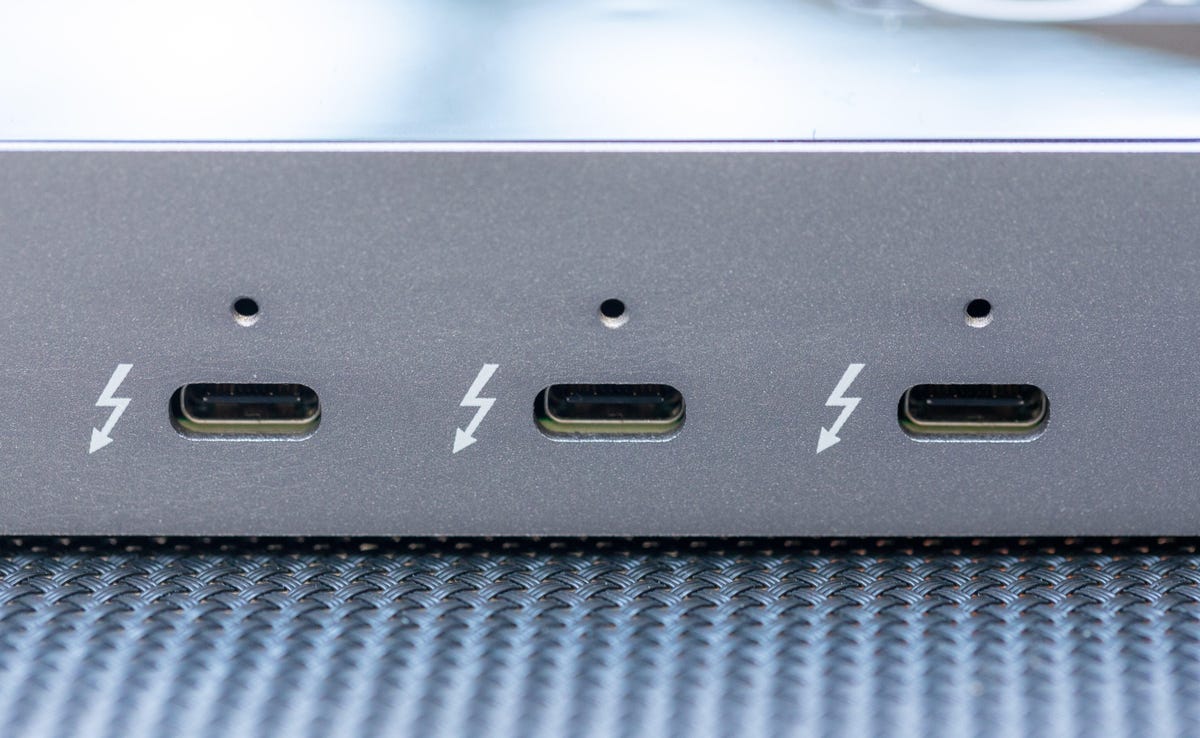
The OWC Thunderbolt dock takes advantage of a Thunderbolt 4 ability, the option to include three ports on one dock or hub. They work as either Thunderbolt or USB-C ports.
Stephen Shankland/CNET"I believe USB will be the step-down, more consumer-grade interface," O'Connor said. "Thunderbolt [will provide] the higher-end capability and reliability."
One significant difference between Thunderbolt and USB is the former's rigorous certification process. USB certification is somewhat chaotic and uncertain. For example, figuring out whether a USB-C cable supports high-power charging or the fastest data rates can involve some guesswork. That's all guaranteed with Thunderbolt. The thousandth Thunderbolt-certified device has just been approved.
Another tailwind for Thunderbolt is the falling price premium for peripherals compared to earlier Thunderbolt products. For example, CalDigit offers a Thunderbolt hub costing $179 and OWC's rival costs $149. That's still about three to four times what a USB hub costs, but so far, USB hubs don't offer multiple USB-C ports or support multiple 4K monitors. More people will benefit from Thunderbolt's top speeds as devices like 4K monitors become cheaper.
Intel continues its investment in Thunderbolt. That's good news for PC makers like Lenovo, which would like smoother Microsoft Windows support, lower power consumption, faster speeds and support for more monitors. Thunderbolt can handle two 4K displays.
Intel isn't detailing its Thunderbolt plans for the moment. But Intel's Ziller says the company will make Thunderbolt faster and easier to use.
"Simplicity, reliability and performance," he said, "are all important."
Source
Apple sues pegasus for spyware maker how to check if your license apple sues pegasus for spyware maker how to check if your registered apple sues pegasus for spyware maker how to check if a business apple sues pegasus for spyware maker s mark apple sues pegasus for spyware makerflo apple sues pegasus for kids apple sues pegasus for sale apple sues pegasus for a summer apple sues pegasus for coloring apple sues pegasus for windows

Apple sues Pegasus for spyware maker. How to check if your iPhone has NSO Group software
In the ongoing battle between Apple and the Pegasus spyware, the iPhone maker today said it was suing the NSO Group -- the maker of surveillance software. Apple said it is seeking to protect its users from "further abuse and harm" with a permanent injunction to ban NSO Group from using the iPhone maker's hardware, software or devices, Apple said in a release.
The spyware can be remotely installed on a target's iPhone or iPad, granting the person or organization who installed it full access to the device and all the data it holds -- without the owner taking any action. That includes text messages, emails and even recording phone calls. Pegasus was originally designed and is marketed by its creator the NSO Group to monitor criminals and terrorists.
Apple with an iPhone security patch in iOS 14.8 in September closed a vulnerability reportedly exploited by invasive spyware built by NSO Group.
While's there probably little chance a government entity would install Pegasus on your iPhone to monitor your activities, if you are curious, there's a free tool that allows you to check your iPhone or iPad with a few clicks. To be clear, the odds of your iPhone or iPad being infected by the Pegasus spyware are low. That said, if you want peace of mind -- just in case -- here's what you need to do, along with installing the iOS update.
Download and install iMazing's app on your Mac or PC
iMazing has updated its desktop app to include Amnesty International's Mobile Verification Toolkit, which was built to detect signs of Pegasus on a device. The company isn't charging for access to the feature.
Download iMazing for your computer from the company's website. Don't worry about buying the app: You can run the full spyware test using just the free trial.
Install iMazing and open it. When prompted, select the free trial.

The longest part is waiting for the app to make a backup of your iPhone or iPad.
Screenshot by Jason Cipriani/CNETHow to run the Pegasus Spyware scan on your iPhone or iPad
With iMazing installed and running, connect your iPhone or iPad to the computer. You may have to enter the Lock Screen code on your device to approve the connection before proceeding (something to keep in mind if your iPhone or iPad isn't showing up in iMazing).
Next, scroll down through the action options on the right-hand side of iMazing until you locate Detect Spyware; click it.
A new window will open, guiding you through the process. The tool works by creating a local backup of your device (so you'll need to make sure you have enough storage space for the backup), and then analyzing that backup. It's an automated task, so you don't have to stick around to monitor it once you click start.
iMazing suggests leaving all of the default settings in place as you click through each screen. There are configuration options built into the tool for advanced users, but for most of us (including myself), the default configuration settings will get the job done.
After going through the basic configuration, you'll need to accept a license for the tool and then click the Start Analysis button.
Once the process starts, make sure you leave your iPhone or iPad connected until it's finished. I ran the test on my iPhone 12 Pro and it took around 30 minutes to create the backup and another five minutes for it to be analyzed. After the backup was created, I did have to enter my account password to allow iMazing to begin analyzing the file. Because of that, I recommend starting the tool and checking on it after a while.
Once iMazing begins analyzing your device's backup, it'll show you its progress by displaying each individual app it's checking, starting with iMessage. The app is using a database of known "malicious email addresses, links, process names and file names"
When iMazing finishes, you'll see an alert with the results. In my case, my iPhone 12 Pro showed no signs of infection and had 0 warnings.
The alert also includes two buttons to open or reveal the report. I looked through my report, and it contained a bunch of random links that meant nothing to me.

At the end of the scan, the results are displayed in an easy-to-read alert.
Screenshot by Jason Cipriani/CNETWhat to do if the iMazing app says your device has signs of an infection
First of all, don't panic. It could be a false positive. If this happens, iMazing asks that you send the report (click Reveal Report to go directly to the file) to its customer support team for further analysis. The company does suggest, however, that if you or a family member are active in a "politically sensitive context" and have a positive report to immediately remove your SIM card and turn off your iPhone or iPad.
If your phone is not infected, you still want to install the latest update on your iPhone, iPad, Apple Watch and Mac, which addresses the vulnerability.
For more security tips, double-check these settings. For added privacy, go through these steps.
Source
10 apps for editing photos before you post to instagram from desktop 10 apps for editing photos before you post to instagram from mac 10 apps for editing photos before you post to instagram story 10 apps for editing photos before you post to instagram on laptop 10 apps for editing photos before you post to instagram from chrome 10 apps for editing photos before you post too much 10 apps for editing photos before tragedy 10 apps for editing photos before after eyelid free windows 10 apps

10 apps for editing photos before you post to Instagram
Photo Editor by Aviary (Android, iOS) is practically a one-stop shop. This photo editor has everything, from advanced editing capabilities (including the ability to tune brightness, exposure, shadows, highlights, warmth, saturation and vibrance) to filters, effects and overlays. You can also crop and rotate photos, add text to your pictures and doodle directly on your pics with a custom pen tool.
For quick edits, Photo Editor by Aviary features an Enhance section with preset enhancements for different settings, like scenery, food and night-time photos. The Aviary Supply Shop has thousands of filters, frames, stickers and artistic overlays -- all of which are currently free for a limited time.
Source
Buster justice department seizes bitcoin us government seized bitcoin fbi investigates 6 crypto coins justice department seized 3 6 billion justice department usa justice department news justice department website justice department uk
Justice Department seizes $3.6B in bitcoin in its biggest finance bust ever
The US Justice Department seized on Tuesday $3.6 billion in bitcoin that it says is linked to the 2016 hack of the Hong Kong cryptocurrency exchange Bitfinex, which was one of the world's biggest crypto companies. Authorities also arrested two people in Manhattan, charging them with conspiracy to launder cryptocurrency stolen during the hack. The bitcoin total taken in the hack is currently valued at $4.5 billion.
Officials seized over 94,000 bitcoin from Ilya Lichtenstein, 34, and his wife, Heather Morgan, 31. The DOJ said that the seized bitcoin are valued at $3.6 billion, making this the largest financial seizure in the department's history. The seizure shows that law enforcement can follow money through the blockchain, the DOJ said.
"We will not allow cryptocurrency to be a safe haven for money laundering or a zone of lawlessness within our financial system," Kenneth Polite Jr., assistant attorney general for the DOJ's criminal division, said in a statement.
As momentous as the bust is, Morgan has garnered a huge amount of interest because of her odd online past. On her LinkedIn profile, she describes herself as an economist, entrepreneur and irreverent rapper. That's led to viral sharing of articles she's written for the likes of Forbes, including one titled: "Experts share tips to protect your business from cybercriminals." That article includes comments from BitGo, which provided security support for Bitfinex at the time of the 2016 hack.
Then there are the rap videos, performed under the alias Razzlekhan, wherein she variously calls herself the "Turkish Martha Stewart" and "The Crocodile of Wall Street." Her song Versace Bedouin begins: "This song is for the entrepreneurs and hackers, all the misfits and smart slackers." The videos have been taken down on YouTube, but remain shared on Twitter.
The Justice Department's ability to track the allegedly laundered bitcoin is significant. Cryptocurrencies like bitcoin and ether are exchanged on decentralized blockchains, which allow people to send and receive the tokens with anonymity. That anonymity has attracted criminals, with bitcoin and the like often being used as black market currency.
Cryptocurrency use in crime totaled about $14 billion in transfers to illicit addresses last year, according to a January report from Chainalysis. However, crime accounted for less than 1% of cryptocurrency transactions last year.
The DOJ said, citing court documents, that the Bitfinex hacker sent 119,754 bitcoin to Lichtenstein's digital wallet through a series of 2,000 transactions. Around 25,000 bitcoin -- today worth about $1 billion -- were transferred out of his wallet. Lichtenstein allegedly attempted to disguise these stolen tokens, but the DOJ said it was able to follow his transactions on the blockchain. The department alleges that some bitcoin were used to buy gold and NFTs, while others were translated into funds that appeared in Lichtenstein and Morgan's bank accounts.
The remaining 94,000 bitcoin are what was seized Tuesday. If convicted, both Lichtenstein and Morgan could face up to 20 years in prison for conspiracy to commit money laundering, plus five years for conspiracy to defraud the United States.
Source
Acer halo is a colorful contribution to the company acer halo is a colorful contribution to hsa acer halo is a colorful contribution synonym acer halo is a colorful contribution meaning acer halo is a colorful contribution limits acer halo is a colorful contribution definition acer halo is a colorful small acer halo isabel acer halo iso acer halo island

Acer Halo is a colorful contribution to the smart speaker market
If you're interested in smart speakers, but not impressed by what you've seen from Amazon, Google or Apple, there are third-party speakers out there. Acer on Wednesday announced the Acer Halo, a $109 smart speaker with DTS sound, LED display and more.
The Acer Halo sits on a base lit up by RGB lighting you can customize. The glowing lights can sync with streaming music, too. That music streams from a speaker with DTS sound designed to project in 360 degrees to fill the room.
On the front of the speaker's gray fabric cover, an LED light display provides visual information like weather or time. Acer is working on an app that will let you personalize the message or image displayed via LED.

An LED display on the front of the speaker displays information.
AcerThe smarts behind this speaker come from Google Assistant. You'll use the usual "Hey, Google" voice command to request music, podcasts, news and answers to questions. The Acer Halo is equipped with two far-field omnidirectional microphones to detect ambient noise and voice commands. A physical switch is available to mute the microphones.
Acer isn't the first third-party manufacturer to try its hand at a smart speaker. We've seen successful models from Bose and Sonos, among others. The Acer Halo Smart Speaker will be available in North America in early 2021 starting at $109. Its European price of 119 euros converts to about £110 or AU$200.
Source
Stress of buying first home stress of buying a house what constitutes a first time homebuyer who is considered a first time homebuyer what qualifies as a first time homebuyer being a first year college student being a first time manager being an ally being a karen

Being a First-Time Homebuyer Can Be Stressful. Here's Everything You Need to Know.
Buying your first home is one of the most meaningful and long-lasting financial decisions you will ever make. It's a major event in many people's lives -- which is why it's important to understand the full picture of the home buying process. Being aware of all of the options available to you -- whether it comes to choosing your realtor, mortgage lender or type of mortgage -- will help you make the right decision for you.
Here is everything you need to know about buying a home for the first time in 11 simple steps.
What is a first-time homebuyer?
Generally speaking, a first-time homebuyer hasn't owned a home before. That may seem obvious, but the definition of a first-time homebuyer is broader than you might expect. You could also qualify as a first-time homebuyer if you've been a homeowner in the past -- as long as you haven't owned a home for at least three years.
First-time homebuyers are often eligible for specific programs and discounts that can make buying a home more affordable. For example, an FHA loan, which is backed by the Federal Housing Administration, is designed to help first-time buyers. It requires as little as a 3.5% down payment, for example. And while most mortgages require a credit score of at least 620, you can secure an FHA loan with a credit score of 580. If your credit score is slightly lower, say between 500 and 579, you could still qualify for an FHA loan, but the down payment requirement jumps up to 10%.
There are first-time homebuyer programs available at the state level, too, so be sure to look into local programs in your area.
Now we'll walk you through the steps of buying a home. Here's how to get started.
1. Review your finances
You need to have your finances in order to be approved for a mortgage. Mortgage lenders want to see that you have good credit, so your credit score is one of the most important factors taken into consideration. That's why it's a good idea to prioritize paying down high-interest debt before you prepare to buy a house, and make sure to check your credit report. Through the end of this year, you can receive one free credit report per week from each credit bureau through AnnualCreditReport.com.
In general, lenders will want to know almost everything about your financial life. You'll be required to show proof of income (you'll need supporting documents like your W-2, pay stubs and an employment verification letter from your job) so they know you can afford the monthly payments. Mortgage lenders will also consider your debt-to-income ratio, which is the amount you pay toward all your debt each month divided by your monthly income. This includes auto loans, student loans, credit card debt and any other debt you're making monthly payments on. It's another reason why it's critical to pay down your consumer debt first.
You also need to know how much you can afford overall. A general rule of thumb is that housing should take up no more than 30% of your monthly income. For example, if your combined income between yourself and your partner is $6,000 a month, your monthly payments should be no more than $1,800. You can use CNET's mortgage calculator to better calculate how much house you can afford.
2. Determine how much down payment you can afford
Another reason to pay off debt before buying a home is that you can free up the money you were putting toward credit card and loan payments to save for a larger down payment. A down payment of 20% or more may help you secure a lower interest rate, lower your monthly payments and make you an attractive candidate to mortgage lenders. While first-time homebuyers don't necessarily need to make large down payments, if you're able to pay more upfront or solicit family help with your down payment, it can make you a more viable applicant, which can help you secure a home more easily in a competitive housing market.
There's another reason to pay more upfront if you can afford to -- if your down payment is less than 20% for a conventional loan, you'll be required to purchase private mortgage insurance, which will be tacked onto your monthly mortgage payments, boosting your monthly housing expenses. (Note: You can get rid of PMI once you've built up 20% equity in your home.)
If you can afford even more, we don't recommend putting all the money you have in your bank account toward a down payment. You also have to be prepared to pay for things like closing costs and other fees associated with the purchase process. Plus, depending on your home inspection, there may be repairs you'll need to pay for after receiving the keys to your home.
If you can't afford a 20% down payment, there are programs available for first-time homebuyers to help.
3. Know your home loan options
Knowing all of the types of mortgages available can help you find the best home loan program for your financial situation. While the most common type of home loan is a conventional 30-year fixed mortgage, which refers to a traditional private loan from a bank, the right loan type for you will vary depending on your specific situation.
Here are some of the most popular types of home loans:
FHA loans : This home loan is backed by the Federal Housing Administration, a government agency, and typically requires a minimum credit score of 620, a down payment as small as 3.5% and the purchase of a Mortgage Insurance Premium, which cannot be removed from the home loan until you've built up at least 20% equity in your home.
VA loans : A VA loan requires a 0% down payment and is only available to current or former members of the military and their spouses. VA loans are backed by the US Department of Veterans Affairs and generally only require a 580 credit score. They also have lower interest rates than other loans, which can save you tens of thousands of dollars over the course of your mortgage.
USDA loans : A USDA home loan is backed by the US Department of Agriculture and is geared toward homebuyers in designated rural areas. A USDA loan requires a minimum credit score of 640 and may not require a down payment. It also offers a lower interest rate than most other kinds of loans.
Fannie Mae Conventional : Conventional mortgages are not backed by the US government and are instead backed by traditional banks and financial institutions. If you're not eligible for a government-backed home loan, conventional loans, which include 30-year fixed-rate and 15-year fixed-rate mortgages, are a good alternative. This home loan requires a minimum 3% down payment and a credit score of at least 620. Conventional home loans are the most common mortgage types in the US and 90% of Americans have a 30-year, fixed-rate loan.
Freddie Mac Home Possible : Home Possible loans are designed for lower-income buyers -- your income, combined with the income of any co-borrower, cannot exceed 80% of your area's median income to qualify. The minimum required down payment is 3% and you generally need a credit score of 660.
Fannie Mae HomeReady Mortgage : HomeReady mortgages are similar to Home Possible loans, but you can have a credit score as low as 620. It also only requires a 3% minimum down payment, which you may be able to cover through grants or gifts from sources like non-profit organizations, churches or family members. No minimum personal funds are required.
Good Neighbor Next Door : This home loan program is available to prospective homebuyers who are law enforcement officers, teachers, firefighters and EMTs and are interested in buying a home in a qualifying revitalization area. The Good Neighbor Next Door program offers you a 50% discount on the list price of the home as long as it remains your primary residence for at least 36 months.
Energy Efficient Mortgage : Anyone who qualifies for a home loan will qualify for an Energy Efficient Mortgage. This type of loan can help you save on utility bills and afford energy-efficient improvements to your property -- savings you can use to pay off your mortgage every month. The Federal Housing Administration insures the mortgage, including the costs of the energy improvements you make to your home. You can use an EEM to purchase a new home or refinance your existing mortgage.
4. Find the right real estate agent
Next, you'll want to find a professional, experienced realtor who is well reviewed online, and understands the market where you're looking for your first home. You can reach out to local brokerages and interview agents until you find one that feels right to you. You'll want to work with an agent who communicates well with you. Trust your gut and make sure they're responsive and knowledgeable before signing any paperwork.
Think of your realtor as your manager during the process -- use them as a resource to source the other professionals you work with. For example, a trusted realtor can help you find the right mortgage lender because they may know about specific rates that you wouldn't otherwise be aware of, which could save you thousands of dollars over the life of your loan.
"If I know that someone is looking to buy in a certain area, I will send them to a certain lender because I know they have special rates available in particular areas," said Adam Shulman, a realtor with Remax Destiny in Cambridge, Massachusetts.
Of course, the lender you work with is ultimately up to you. But you can lean on your real estate agent for support and advice.
5. Compare rates from different lenders and get prequalified
While mortgage rates fluctuate on a daily basis depending on what's happening with the economy, you still want to shop around to find the best rates, as they will vary lender by lender. Sourcing multiple quotes from multiple lenders will save you money -- borrowers can save an average of $1,500 just by getting one extra quote, and an average of $3,000 by getting five quotes, according to Freddie Mac.
To gain access to rates online, you'll typically need to provide some basic financial information, which the lender will use to prequalify you for a mortgage. Prequalification does not guarantee these rates, but rather allows you to view rates you're likely to lock in based on your finances. This step, which is different than mortgage preapproval, typically does not require a credit check.
When reviewing interest rates, you also need to factor in lender fees, such as underwriting, origination and points fees. If a lender charges high fees, you could actually end up paying more even if they offer a lower interest rate. Lender fees, combined with the interest rates, create your annual percentage rate, which is the actual rate you'll pay for the home loan.
"Too many people just shop by interest rate," said Frank Jacovini, associate broker with Remax Century in Philadelphia. "But the fees are built into the calculation of the APR. The APR gives you a true picture of the cost of that loan."
For example, one lender may offer a 3.9% interest rate while another is offering a 3.75% interest rate -- but the lender offering a 3.75% interest rate may be charging you a $5,000 origination fee, making your APR higher. That's why looking at the APR is a better way to compare options across lenders.
6. Get preapproved
Getting preapproved for a mortgage gives you an estimate of what you'll be able to borrow and verifies your creditworthiness. This allows the sellers and everyone you're working with to know that you can actually afford the offer you're making on your first home. In this competitive market, getting preapproved is crucial.
To get preapproved, you'll need to submit financial documents, like pay stubs and bank statements, to a lender. They'll also run a credit check. You'll then receive a preapproval letter indicating how much of a home loan you're preapproved for. Keep in mind, this amount may vary from the amount you'll be officially approved for later on, but it's a good barometer to use when shopping for homes.
If you're not preapproved for a mortgage in today's market, it's likely the seller won't even entertain your offer, said Jacovini. Having a preapproval letter is especially valuable in this record-high housing market.
"If there are multiple bids as soon as a house comes on the market, you need to be able to move fast," said Jacovini. "That's why having the preapproval first is important -- if you're going to make an offer on a new listing that just hit the market, you need that preapproval to get your offer out within a day or so."
7. Shop for your home
This is the part where you get to scroll through Zillow -- and not just window shop. Looking for a home online has become something of a national pastime, but you should also go to local open houses, as well as talk to realtors, brokers and other people in your neighborhood who have recently purchased their first home.
You'll want to decide at this step what features are important to you in a home: the number of bedrooms and bathrooms, square footage and home type, for example. Let your real estate agent know what are must-haves in a home and they'll be able to send you houses to review as soon as they hit the market.
Don't buy the first house you see. And though it may be tempting in this skyrocketing housing market, avoid buying a home you're not able to view in person, if possible.
8. Make an offer, quickly
You want to put your strongest foot forward when making an offer as a first-time homebuyer. Making your highest and best offer first is usually what realtors recommend in order for it to be competitive, which is particularly important right now.
In today's extreme seller's market, you need to be prepared to make that offer quickly, which is why it's critical you have all of your finances and documents ready to go. Normally, you might have contingencies or concessions from the seller in your offer, which dictate conditions the seller must meet before the closing date, but in today's market many buyers are avoiding contingencies in order to make their offers more attractive.
9. Negotiate closing costs
For a buyer, closing costs are fees you pay for your mortgage lender's services. They include expenses like title insurance, lawyer fees and your home appraisal, as well as taxes. Sometimes you can roll your closing costs into your loan so you don't have to pay them out of pocket. In some cases, you may even be able to get your closing costs covered as a gift or a grant through a charitable organization if you meet certain eligibility requirements.
Your closing costs will add up to thousands of dollars. The average closing costs for a single-family home purchase were $6,387 in the first half of 2021, but they vary widely depending on where you live. For example, in high-demand places such as New York, average closing costs can be as high as $17,000. Typically, your closing costs will be around 2% to 5% of your loan.
10. Schedule an inspection
You may be tempted to waive a full inspection in this red-hot housing market, but it could cost you thousands of dollars down the line if any critical issues are overlooked in the home you're buying. Typically, you have an inspection performed on the home once you make an offer, but these days another option in such a tight market is to do a full inspection before making an offer.
Paying for a home inspection before making an offer may seem strange, but it can offer peace of mind without delaying your offer. "You can still get an inspection done, but your offer is stronger because it won't be contingent on the results of the inspection," said Shulman. As a buyer, you're responsible to pay for the inspection: The average cost ranges from $300-$500, but can be as high as $900 in highly sought-after areas.
A thorough inspection should take anywhere from 2 to 4 hours. You should avoid the recent trend of "walk and talk" inspections that only take a quick look at the home and overlook the rest of the inspection process. Make sure you receive a written report after an inspection -- the inspector is legally obligated to provide you with the report.
11. Prepare to close on your home
Before your closing date, you need to make sure your investment in your new home is protected by purchasing homeowners insurance. Most mortgage lenders require you to buy homeowners insurance, so you need to factor it into your monthly budget when figuring out how much you can afford. For example, the average homeowner spends $1,383 on homeowners insurance for a $250,000 house, which means you'd need to factor in an additional $115 per month to your budget.
The day you close on your home is the day when the property is actually transferred to you and when you'll be expected to pay the closing costs, which are generally around 2% to 5% of your loan total. Closing costs must be paid with a cashier's check from your bank, never a personal check. Before your closing date, you need to make sure all of your paperwork is signed -- by both buyer and seller -- so the house officially can become yours. This is also when the title company needs to verify your identity with a valid photo ID. You'll need proof that you've already purchased homeowners insurance if your bank requires it. Make sure you have all of your documents and paperwork lined up in advance so you're ready to go the day of.
Don't forget to factor in the cost of your physical move, either. Hiring a moving company can cost you hundreds or thousands of dollars depending on the amount of furniture you're moving and the location of your move. Moving from a three-bedroom on average can cost anywhere from $480 to $800, according to Zillow.
Source
Honda accord cr v under investigation by nhtsa over phantom fireworks honda accord cr v under investigation by nhtsa over phantom gourmet honda accord cr v under investigation by nhtsa over phantom tollbooth honda accord cr v under investigation by nhtsa complaints honda accord cr v under investigation by dea honda accord cr v under investigation with liz honda accord cr v under investigation synonym honda accord cr v under 10000 honda accord hybrid honda accord parts

Honda Accord, CR-V Under Investigation by NHTSA Over Phantom Braking
Honda is facing an investigation by the National Highway Traffic Safety Administration over concerns that 1.7 million of its CR-VSUVs and Accordsedans produced between 2017 and 2019 could experience phantom braking, according to a report Thursday by the Associated Press.
Phantom braking is an issue where a vehicle equipped with an automatic emergency braking system will apply the brakes without warning or provocation. This is dangerous because it can cause a loss of control and because sudden, violent applications of a vehicle's brakes can increase the likelihood of rear-end collisions and injuries, which have been reported in at least six cases with the Hondas in question.
The investigation seeks to understand not only the cause of the issue but its full scope and scale and will likely lead to a recall action. Honda says it's cooperating fully with NHTSA to get to the bottom of this issue.
Of course, Honda is far from the only company to experience phantom braking issues, with Tesla regularly being mentioned in complaints to the NHTSA. Our own experience with the problem in our long-term test Model Y has been so severe and frequent enough that it led us to recommend that our readers not buy a Tesla until the issue has been fully resolved.
We asked Honda for comment but didn't hear back in time for publication.
Source
How to secure your android phone how to make android phone secure how to become more secure 6 tips to help ace your video interview tips and get help 6 tips to help you enjoy your daily routines 6 tips for managing stress

6 Tips to Help Secure Your Android Device Data
This story is part of War in Ukraine, CNET's coverage of events there and of the wider effects on the world.
It's been over a month since Russia invaded Ukraine, and worries about cybersecurity continue to grow. Even before the invasion, US officials blamed Russia for cyberattacks against some Ukrainian websites, including Ukraine's Ministry of Defense and two banks.
While the US Cybersecurity and Infrastructure Security Agency said there are no specific or credible cyberthreats against the US, the agency also said potential cyberattacks are more likely to target infrastructure. CISA is recommending everyone be prepared just in case. And securing your mobile device is a good place to start when building a line of cyberdefense. Here are six steps Android users can take to protect their phone data.
Make sure your OS is up to date
Updating your operating system can patch known security vulnerabilities and fix bugs. Not updating to the latest version leaves you and your device open to flaws that could expose personal data to malicious actors. Some people might put off updating their OS so they don't have to deal with early bugs in the system, but waiting too long can harm your system. Here's what to know about the latest Android OS, Android 12.
Turn on two-factor authentication
Two-factor authentication , or 2FA, adds a second layer of security to your Android account in case your password gets stolen. With 2FA, once you enter your password, a second message is sent to another device asking to verify that you are trying to login. It adds a bit more time to your login process, but the extra layer of security is well worth it. Here's how to turn on 2FA.
Use a password manager
If you're having trouble memorizing multiple passwords and coming up with unique passwords for every account, a password manager can help. These utilities can work hand-in-hand with 2FA and can securely store passwords and automatically fill login pages. They can also protect you against phishing scams that direct you to enter your password into a fraudulent website. For more information, check out CNET's reviews of password managers Bitwarden, LastPass and 1Password.
Encrypt your Android
Starting in 2015, Google required manufacturers to make Android devices encryptable out of the box. Once your device is encrypted, all data stored on the device is locked behind a PIN code, fingerprint, pattern or password known by the owner. Without that key, not even Google can unlock your device. Here you can find out how to encrypt your phone.
Remove your data from Google
Android is a Google product, so unencrypted device data could be stored on a Google server. You can check with Google to see what data of yours it has, and you can ask Google to delete that data. The process can take time, but it's worth the effort -- your data can't be stolen if it's not in the system to begin with. Here's where you can find how to request Google to delete your information, but note that Google does not guarantee that it will complete the request.
When all else fails, delete your phone
If you lose your phone or it's stolen, you can remotely wipe your phone. Our Android settings guide has a walkthrough in case you need to take this step. This gets rid of all data from your phone so if you have anything on it you want to keep, you should get in the habit of backing your phone up on a separate device.
For more information on securing your phone, check out these eight apps to protect your phone's privacy, what information digital security experts wish you knew and how to stop your phone from tracking you.
Source
8 ways to protect your money during renaissance 8 ways to protect your money during renasant email breach 8 ways to protect yourself 8 ways to avoid probate 8 ways to spot counterfeit money 8 ways to improve parent child relationship 8 ways to survive the narcissist

8 Ways to Protect Your Money During a Recession
This story is part of Recession Help Desk, CNET's coverage of how to make smart money moves in an uncertain economy.
What's happening
With the latest GDP report showing another consecutive quarterly decline in economic activity, the country is likely in a technical recession.
Why it matters
Previous recessions have all seen pervasive layoffs, higher costs of borrowing and a tumultuous stock market.
What it means for you
Worry less about the macroeconomic news of the day and focus on what you can control. Take inventory of your financial life, gather facts and make moves to protect your savings.
While many economists still refuse to use the R-word, the warning signs indicate the US economy is now likely in a technical recession. In addition to another quarterly drop in GDP, or gross domestic product, consumer confidence has gone down, the stock market is in bear territory and inflation is still soaring, despite four interest rates hikes from the Federal Reserve.
An increase in layoffs -- another key indicator of a recession -- is also being felt across the country as many companies, particularly in the tech sector, have announced layoffs in recent months. And if you ask most people, they'll say it's become undoubtedly harder to make ends meet. At least one poll conducted in June finds a majority of Americans, or 58%, believe we are in a recession.
But then others point to some key factors that point in the opposite direction -- for example, low unemployment levels, rising spending and a healthy banking sector.
While the National Bureau of Economic Research makes the official call on a recession -- and so far it's remained tight-lipped -- whether we call this challenging financial period a recession or not seems like a pretty subjective matter of interpretation.
At CNET Money, we're dedicated to supporting your financial health with accurate, timely and honest advice that takes into consideration the pressing financial questions of our time. That's why we're launching the Recession Help Desk, a destination where you will get the latest, best advice and action steps for navigating this uncertain period.
First, a quick look back at the US economy
Since the Great Depression, the US has had about a dozen economic setback periods lasting anywhere from a few months to over a year. In some ways, there's always a recession on the horizon: Economies are cyclical, with upswings and downturns. We can't predict what will happen in advance, and sometimes we can't even tell what's happening while we're in the middle of it. Morgan Housel, author of The Psychology of Money, may have said it best when he tweeted back in April: "We're definitely heading toward a recession. The only thing that's uncertain is the timing, location, duration, magnitude and policy response."
Attempting to figure out recession specifics is a guessing game. Anyone who tells you different is likely trying to sell you something. The best we can do right now is draw on history to build context, get more proactive about the money moves we can control and resist the urge to panic. This includes reviewing what happened in previous recessions and taking a closer look at our financial goals to see what levers to pull to stay on track.
Here are eight specific steps you can take to create more financial stability and resilience in a turbulent economy.
Read more: Bear Markets: Expert Stock Market Advice for Investors
1. Plan more, panic less
The silver lining to current recession predictions is that they're still only forecasts. There is time to assemble a plan without the real pressures and challenges that come with being in the thick of an economic slowdown. Over the next couple of months, review your financial plan and map out some worst-case scenarios when your adrenaline isn't running high.
Some questions to consider: If you did lose your job later this year or in early 2023, what would be your plan? How can you fortify your finances now to weather a layoff? (Keep reading for related advice.)
2. Bulk up your cash reserves
A key to navigating a recession relatively unscathed is having cash in the bank. The steep 10% unemployment rate during the Great Recession in 2009 taught us this. On average, it took eight to nine months for those affected to land on their feet. Those fortunate to have robust emergency accounts were able to continue paying their housing costs and buy time to figure out next steps with less stress.
Consider retooling your budget to allocate more into savings now to hit closer to the recommended six- to nine-month rainy day reserve. It may make sense to unplug from recurring subscriptions, but a better strategy that won't feel as depriving may be to call billers (from utility companies to cable to car insurance) and ask for discounts and promotions. Speak specifically with customer retention departments to see what offers they can extend to keep you from canceling your plans.
3. Seek a second income stream
Web searches for "side hustles" are always popular, but especially now, as many look to diversify income streams in the run up to a potential recession. Just like it helps to diversify investments, diversifying income streams can reduce the income volatility that arrives with job loss. For inspiration on easy, low-lift side hustles that you might be able to do from home, check out my story.
4. Resist impulsive investing moves
It's hard not to be worried about your portfolio after all the red arrows in the stock market this year. If you have more than 10 or 15 years until retirement, history proves it's better to stick with the market ups and downs. According to Fidelity, those who stayed invested in target-date funds, which include mutual funds and ETFs commonly tied to a retirement date, during the 2008 to 2009 financial crisis had higher account balances by 2011 than those who reduced or halted their contributions. "Those who panic and sell 'at the bottom' often regret it because trying to time the market can result in losses that are very difficult to regain because stock prices can change quickly," said Linda Davis Taylor, seasoned investment professional and author of The Business of Family.
If you have yet to sign up for automatic rebalancing, definitely look into this with your portfolio manager or online broker. This feature can ensure that your instruments remain properly weighted and aligned with your risk tolerance and investment goals, even as the market swings.
5. Lock interest rates now
As the policy makers raise interest rates to bring down inflation levels, interest rates will increase. This potentially spells bad news for anyone with an adjustable-rate loan. It's also a challenge for those carrying a balance on a credit card.
While federal student loan borrowers don't have to worry about their rates going up, those with private variable rate loans may want to look into consolidating or refinancing options through an existing lender or other banks, such as SoFi, that could consolidate the debt into one fixed-rate loan. This will prevent your monthly payments from increasing unpredictably when the Federal Reserve raises interest rates again this year, as expected.
6. Protect your credit score
Borrowers may have a tougher time accessing credit in recessions, as interest rates jump and banks enforce stricter lending rules. To qualify for the best loan terms and rates, aim for a strong credit score in the 700s or higher. You can typically check your credit score for free through your existing bank or lender, and you can also receive free weekly credit reports from each of the three main credit bureaus through the end of the year from AnnualCreditReport.com.
To improve your credit score, work towards paying down high balances, review and dispute any errors that may be on your credit report or consider consolidating high-interest credit card debt into a lower interest debt consolidation loan or 0% introductory APR balance transfer card.
7. Rethink buying a home
While home prices have cooled in some areas, it remains a competitive housing market with few homes to go around. If rising mortgage rates are adding more pressure to your ability to buy a home within budget, consider renting for a little longer. If you're also worried about your job security in a potential recession, then that's even more reason to take pause. Leasing isn't cheap at the moment, but it can afford you more flexibility and mobility. Without the need to park cash for a down payment and closing costs, renting can also keep you more liquid during a potentially challenging economy.
8. Take care of your valuables
The advice that was born out of the sky-high inflation period in the late 1970s still applies now: "If it ain't broke, don't fix it."
With ongoing supply chain issues, many of us face high prices and delays in acquiring new cars, tech products, furniture, home materials and even contact lenses. This includes replacement parts, too. If a product comes with a free warranty, be sure to sign up. And if it's a nominal fee to extend the insurance, it may be worth it during a time when prices are on the rise.
For example, my car has been in the repair shop for over three months, waiting for parts to arrive from overseas. So, in addition to paying my monthly car payment, I have a rental car fee that's adding up. If nothing else, I'll be heading into a possible recession a more cautious driver.
Read more: Smaller Packages, Same Prices: Shrinkflation Is Sneaky
Source
